

Geothermal Energy Applications and the Role of Plate Heat Exchangers in Modern Thermal Systems
Geothermal energy is gaining renewed attention as the energy transition expands beyond electricity generation alone. In this context, plate heat exchangers play an important role because they help transfer subsurface heat into usable, stable, and maintainable thermal systems.
As the energy transition expands beyond electricity alone, geothermal energy is receiving renewed attention not only as a renewable power source, but as a practical thermal resource for heating, cooling, and industrial use. The value of this resource lies in its versatility.
Depending on the temperature of the resource and the way the system is configured, it can be used for power generation, district heating, building HVAC, greenhouse and aquaculture heating, and a range of industrial thermal processes. The International Energy Agency describes it as a resource with broad potential for electricity generation as well as heating and cooling, while the U.S. Department of Energy highlights direct-use applications such as district heating, greenhouses, aquaculture, and industrial process heat.
What links these applications is not simply access to subsurface heat. In practice, this energy becomes useful only when resource-side heat can be transferred into a stable, controllable, and maintainable system.
That is why heat exchangers occupy such an important place in these projects. Among the available heat-exchange technologies, plate heat exchangers are especially relevant because they combine compactness, high thermal effectiveness, and fluid-side separation in a form that can be integrated into a wide range of system architectures. Direct-use guidance from DOE and building-sector references both note that heat exchangers are commonly used to transfer underground heat to secondary fluids or downstream systems.
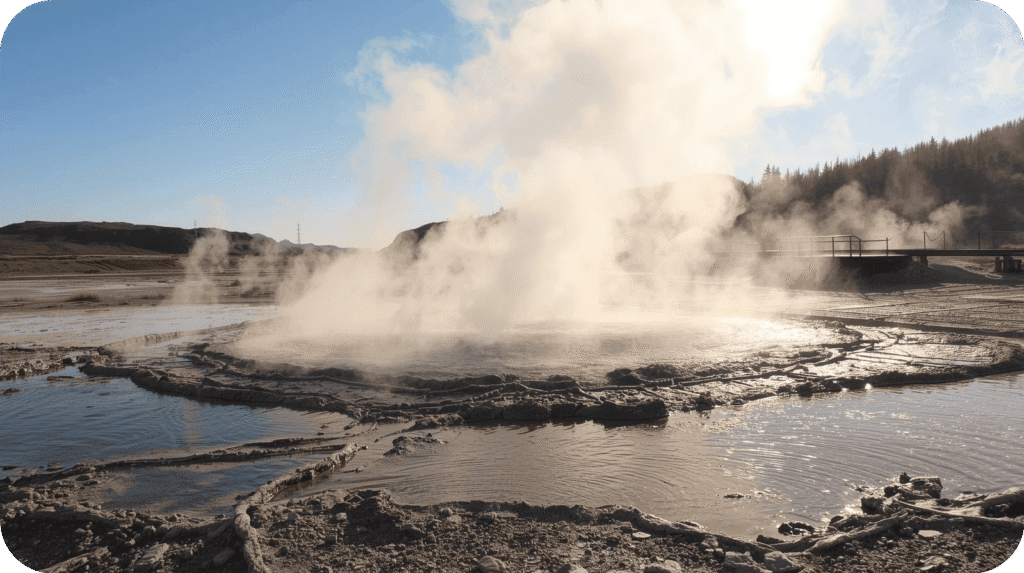
Geothermal Use Is Broader Than Power Generation
This resource is often associated first with power plants, especially in regions with high-temperature reservoirs. That association is understandable, but incomplete.
In engineering terms, its utilization is better understood as a family of applications organized by resource temperature, flow conditions, and end-use requirements.
At higher temperatures, it can support electricity generation, including flash or steam-based systems in favorable reservoirs. At moderate and lower temperatures, it is more commonly used in direct-use applications, where the objective is not to convert heat into electricity, but to deliver thermal energy efficiently to buildings, district networks, agricultural systems, or industrial processes.
In addition, shallow geothermal and ground-source heat pump systems use the ground as a heat source or heat sink for building heating and cooling. This wider framing is consistent with the IEA’s description of the resource as a source for electricity, heating, and cooling, and with DOE’s explanation that lower-temperature resources can be applied across multiple direct-use sectors.
This distinction matters because the requirements imposed on the heat exchanger are not the same in every case. In a power plant, the exchanger may be part of a thermodynamic conversion cycle. In district heating, it may define the interface between the primary loop and the secondary network. In a ground-source heat pump system, it may act as an internal evaporator, condenser, or source-side isolator.
The equipment is different in duty, but similar in system significance: it determines how underground heat becomes usable heat.
Where Geothermal Energy Resource Is Used
One of the most established applications is district heating. In these systems, hot water from underground is delivered to heat exchangers or building networks, providing space heating and sometimes domestic hot water. DOE identifies district heating as one of the most common direct-use applications and notes that such systems have existed for more than a century.
Another major application is building heating and cooling through ground-source or water-based heat pump systems. These designs do not necessarily rely on deep, high-temperature reservoirs. Instead, they use the relatively stable thermal conditions of the ground or groundwater to improve HVAC efficiency.
In these architectures, heat exchangers are essential both inside the heat pump unit and, in many open-loop or water-based designs, at the interface between the source side and the building side.
This resource is also used in agriculture and food-related sectors. DOE and direct-use references describe applications such as greenhouse heating, aquaculture temperature control, crop drying, and other process-heating duties. These uses are often based on moderate or low-temperature resources and are especially attractive where a steady thermal supply is more valuable than a high peak temperature.
In industrial settings, underground heat can support processes that require continuous low- to medium-grade thermal input. The advantage in such cases is not that it can replace every conventional heat source, but that it can provide stable thermal energy with low fuel exposure and lower carbon intensity where temperature levels are suitable.
This makes system integration and heat-transfer design more important than the resource alone.
Power generation remains an important pathway, especially where reservoir temperatures are high enough or where lower-temperature resources can be utilized through binary-cycle systems. The IEA identifies both conventional and emerging technologies as part of the sector’s future growth, and DOE notes that lower-temperature resources can also support electricity production in suitable binary configurations.
Why Heat Exchangers Matter
In these projects, the central engineering problem is rarely just how to access heat underground. The more difficult question is how to move that heat into a downstream system without transferring unwanted chemistry, excessive maintenance burden, or unstable operating conditions.
Subsurface fluids are often chemically complex. Depending on the reservoir, they may contain dissolved minerals, salts, gases, suspended solids, or corrosive species. Reviews of geothermal heat exchangers consistently identify corrosion and scaling as major challenges that affect thermal performance, pressure drop, service life, and maintenance planning.
For that reason, a heat exchanger in this service is not merely a compact thermal component. It is a boundary device. It separates the resource side from the user side, the production side from the process side, and the contaminated side from the clean side.
In many systems, this separation is more important than the thermal duty alone.
This is where plate heat exchangers become particularly relevant. Their role is not limited to providing a high heat-transfer coefficient in a small footprint. More fundamentally, they help transform a site-specific resource into a controlled thermal service that can be connected to district networks, heat pumps, process loops, or secondary working fluids.
The Role of Plate Heat Exchangers in Different Applications
In district heating applications, plate heat exchangers are commonly used to isolate production water from the secondary network. This avoids sending mineralized or chemically aggressive fluid directly into building-side piping or terminal equipment.
It also allows operators to localize fouling and maintenance around a more accessible and more easily managed component. Direct-use guidance specifically notes the use of heat exchangers in transferring heat from underground water to secondary fluids, and long-standing project references describe this technology as common equipment in heating applications.
In heat pump systems, this type of exchanger often serves as a practical interface between source water, internal refrigerant circuits, and load-side water loops. In open-loop groundwater systems especially, it can prevent raw well water from circulating directly through the most sensitive parts of the HVAC system.
This improves maintainability and helps preserve more stable internal operating conditions.
In low- and medium-temperature power systems, especially binary-cycle configurations, heat exchangers transfer heat from brine to a secondary working fluid. In this context, exchanger performance has a direct influence on cycle effectiveness because available temperature differences are often limited.
Compact exchanger technology becomes valuable not simply for saving space, but for making better use of restricted thermal driving force. The IEA and DOE both point to the continued relevance of binary-cycle utilization for appropriate resources.
In greenhouse, aquaculture, and industrial direct-use systems, the function is often straightforward but essential. It allows heat to be delivered to the process without requiring the process fluid itself to tolerate the chemistry of production water.
That separation makes integration more practical across a much wider set of users than direct-contact heating would allow.
Why This Technology Fits These Systems Well
Plate heat exchangers are attractive in this service for several system-level reasons.
First, they support thermal efficiency in compact spaces. Many projects, especially building-scale and distributed energy systems, benefit from equipment that can deliver effective heat transfer without large footprints.
Second, they create a clear interface between loops. In these applications, hydraulic and chemical separation is often as important as thermal performance. It allows the designer to isolate the primary side, protect downstream assets, and maintain more standardized conditions on the user side.
Third, they support modular system architecture. In district substations, energy centers, and packaged HVAC equipment, they are relatively easy to integrate as standardized modules. That makes them useful not only in initial construction, but also in phased expansion and retrofit work.
Fourth, they can improve maintainability when selected appropriately. In these systems, maintenance strategy should be part of the design basis from the beginning. A unit that is compact but difficult to inspect or clean may not be a good fit in a fouling-prone service.
The appeal of this technology therefore depends not only on heat-transfer intensity, but on how well the selected configuration aligns with the expected water chemistry and service regime. The technical literature repeatedly emphasizes that corrosion, scaling, and long-term surface condition cannot be treated as secondary issues.
Engineering Considerations in Service
For these applications, the selection of a plate heat exchanger should begin with service conditions rather than with generic performance claims.
The first consideration is scaling. Mineral precipitation can increase thermal resistance, reduce effective channel area, raise pressure drop, and gradually degrade system output. This is one of the most frequently discussed operational issues in exchanger service.
The second is corrosion and materials compatibility. The chemistry of production fluids varies widely, so assumptions based on conventional HVAC water quality are often not adequate. Material selection, surface protection, and maintenance planning all need to reflect the actual composition of the stream.
The third is pressure drop. High heat-transfer performance is valuable, but not if it creates excessive pumping penalties on either side of the system. These installations must be evaluated as whole hydraulic systems, not as isolated exchanger calculations.
The fourth is maintainability. In this service, the best exchanger is rarely the one with the highest nominal thermal intensity alone. It is the one that can deliver stable performance over time under real fouling, chemistry, and maintenance constraints.
From Resource Access to System Integration
The development of geothermal energy depends on more than drilling, reservoir assessment, or resource temperature. It also depends on whether the recovered heat can be integrated into usable systems with acceptable reliability, maintainability, and cost.
That is why heat-transfer architecture deserves more attention in discussions of this sector.
Plate heat exchangers matter because they help convert geothermal energy from a resource into a service. They isolate fluids, define thermal boundaries, support modular system design, and make it easier to connect supply with buildings, district networks, power cycles, and industrial users.
In that sense, their value is not only that they transfer heat efficiently, but that they make the resource usable in the first place.
As deployment broadens from traditional power production into district energy, heat pumps, and direct-use thermal applications, the importance of this interface role will only become more visible. The future of geothermal energy is not just about accessing heat underground. It is about building systems that can use that heat well.